
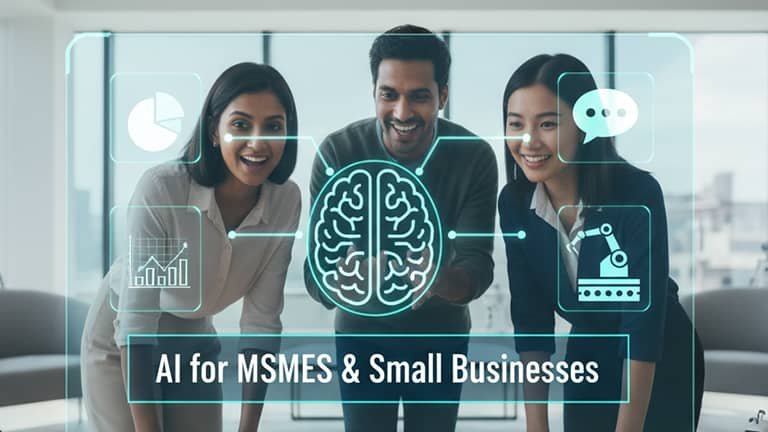
Advanced technologies are no longer exclusively available to large corporations. Modern cloud solutions, SaaS platforms, and AI applications now offer affordable access to startups and smaller enterprises. The integration of AI is rapidly transforming how Indian MSMEs operate, compete, and grow.
Why AI Is Important for Small Businesses
- Cost Effectiveness: Technology reduces operational expenses significantly
- Better Decision-Making: AI-driven analytics helps MSMEs understand customer behavior and market patterns
- Improved Customer Experience: Automated systems and personalization strengthen customer relationships
- Competitive Advantage: Small businesses can compete effectively against larger competitors through digital practices
Applications of AI in MSMEs
Customer Support Automation
AI chatbots function across websites and messaging platforms, providing round-the-clock support by answering questions, tracking orders, and resolving issues without human intervention delays.
Inventory and Supply Chain Management
Predictive systems enable businesses to anticipate customer demand and optimize stock levels, preventing both shortages and excess inventory situations.
Marketing & Sales Insights
Budget-conscious companies benefit from AI analysis of customer preferences, directing marketing investments toward higher-return channels at reduced costs.
Finance and Risk Management
Computerized accounting programs using AI technologies allow monitoring of cash flow, tracing fictitious transactions, and even forecasting of payment delays — giving business owners real-time financial visibility.
HR and Recruitment
Automated resume screening and preliminary candidate assessments save entrepreneurs significant time and effort during hiring processes.
MSME Automation: Minimizing Expenses and Increasing Productivity
Automation augments rather than replaces human work. Automated billing reduces errors while AI quality control systems maintain consistent product standards. Employees can redirect efforts toward innovation and customer engagement, yielding greater productivity alongside cost management.
Digital MSME: A Step Toward Future-Ready Enterprises
Government initiatives encourage technology adoption including AI and cloud computing. With a Udyog Aadhar or a Udyam Registration, businesses can gain access to schemes, subsidies, and training initiatives supporting digital transformation. This makes official MSME registration the gateway to the digital economy.
Real-Life Applications of AI in Indian MSMEs
- Handicrafts Sellers: E-commerce platforms use AI recommendations for product promotion
- Textile Units: Seasonal demand forecasting guides production planning
- Local Cloud Kitchen Startups: Order prediction and optimized delivery routing improve efficiency
- Electronics MSMEs: Machinery performance algorithms prevent equipment failures
Challenges of AI Adoption Amongst MSMEs
- Awareness Gap: Limited knowledge of affordable AI solutions among business owners
- Initial Investment: Hesitation about upfront technology costs despite long-term savings
- Skill Shortage: Workforce training requirements for effective platform usage
- Data Privacy Issues: Customer information protection responsibilities
Solutions require collaboration between government, technology providers, and business associations to overcome these barriers collectively.
Advice for MSMEs to Start their AI Journey
- Start Small: Begin with single-department automation like invoicing or chatbots
- Leverage Free Tools: Many AI platforms offer complimentary versions for small enterprises
- Prepare Employees: Basic digital literacy training prepares staff for implementation
- Avail Government Schemes: Access available subsidies, loans, and training programs linked to Udyam Registration
Incremental approaches enable affordable AI integration without disrupting existing operations.
Conclusion
AI has transitioned from theoretical concept to practical utility for Indian small businesses. Integration of AI for MSMEs and government programs like Udyog Aadhar and Udyam Registration guarantee that technology adoption is no longer a prerogative of large firms but a natural route towards future prospects. Early adopters gain competitive advantages in market access, customer satisfaction, and sustainable growth.