
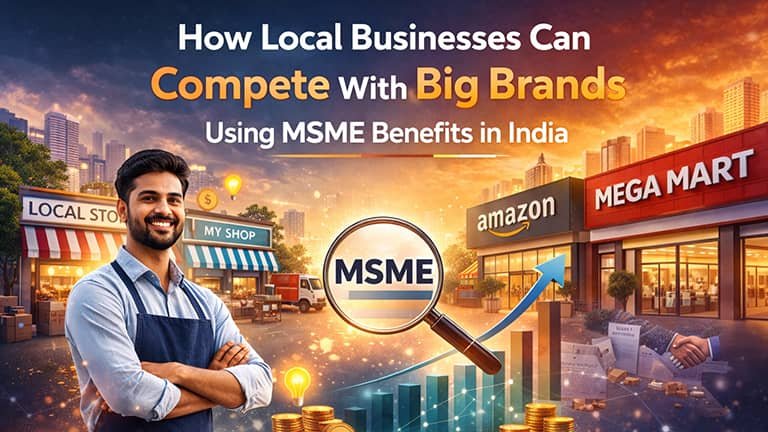
Small enterprises often struggle against large corporations due to limited resources. However, MSME (Micro, Small and Medium Enterprise) registration offers powerful tools for sustainable growth through government-backed support programs designed to help local entrepreneurs compete effectively.
Why Local Businesses Struggle Against Big Brands
Local businesses face several competitive disadvantages compared to large corporations:
- Limited access to capital
- Difficulty securing large contracts
- Higher borrowing costs
- Lower brand visibility
- Delayed payments from buyers
Large brands operate with strong financial backing and professional systems, while small enterprises typically rely on personal savings or informal financing, restricting expansion and marketing capabilities.
How MSME Registration Strengthens Local Businesses
MSME registration provides formal recognition that builds credibility and unlocks access to various incentives from banks, financial institutions, and government departments.
1. Easier Access to Financial Support
Funding remains the biggest challenge for local business expansion. MSME recognition grants access to:
- Collateral-free loans
- Lower interest rates
- Credit guarantee schemes
- Working capital assistance
The Credit Guarantee Fund Trust for Micro and Small Enterprises (CGTMSE) enables small businesses to obtain bank loans without pledging significant assets, allowing investment in technology, quality improvements, and operational expansion.
2. Protection Against Delayed Payments
Cash flow disruption severely impacts small businesses. MSME provisions require buyers to make timely payments within specified timeframes, with interest penalties for delays. This legal safeguard protects entrepreneurs from financial stress caused by delayed receivables when dealing with larger corporate clients.
3. Preference in Government Tenders
Government departments purchase goods and services worth thousands of crores annually. MSMEs receive special consideration in public procurement policies:
- Reserved tenders for MSMEs
- Relaxed eligibility criteria
- Exemption from Earnest Money Deposit (in many cases)
- Price preference advantages
These opportunities enable local manufacturers and service providers to secure stable, long-term contracts in government supply chains. Public procurement opportunities are available at the Government e-Marketplace portal.
4. Subsidies and Cost Reduction Benefits
Government-backed subsidies help MSMEs compete against larger enterprises' economies of scale:
- Subsidies on technology upgrades
- Reimbursement of ISO certification expenses
- Support for participation in trade fairs
- Patent and trademark fee reimbursements
These measures allow small businesses to improve quality standards and brand positioning without massive capital investments.
5. Support for Digital and Marketing Expansion
Digital presence is essential in modern markets. Government schemes encourage MSME digital adoption through assistance with:
- Digital marketing initiatives
- E-commerce platform integration
- Skill development training
- Technology modernization
Improved online presence enables local businesses to compete nationally beyond their geographic regions.
6. Skill Development and Training Programs
Government-supported training equips entrepreneurs with essential business competencies:
- Financial management skills
- Marketing strategies
- Operational efficiency techniques
- Compliance knowledge
This structured guidance empowers small business owners to operate professionally and strategically, similar to large enterprises.
7. Building Trust and Credibility
MSME registration enhances business reputation among stakeholders:
- Banks feel confident lending money
- Corporate clients feel secure placing bulk orders
- Customers perceive higher reliability
This brand trust is essential when competing with well-known companies.
8. Encouraging Innovation and Local Manufacturing
Local businesses possess flexibility advantages over standardized corporate operations. Financial support enables:
- Faster innovation
- Customization for regional markets
- Experimentation with niche offerings
- Improved manufacturing techniques
This agility can become a powerful competitive advantage.
Smart Strategies to Compete With Big Brands
Simply registering as an MSME is insufficient — strategic benefit utilization is necessary.
Focus on Quality and Specialization
Rather than competing solely on price, emphasize quality, niche products, and personalized service offerings that large brands cannot easily replicate.
Leverage Government Support Actively
Maintain awareness of emerging schemes and incentives, as many entrepreneurs miss opportunities through lack of knowledge about available benefits.
Maintain Proper Financial Records
Clean financial documentation significantly increases loan and subsidy approval chances. Invest time in proper bookkeeping.
Invest in Branding
Use cost-saving subsidies to develop professional brand identity through packaging, website development, social media presence, and customer service excellence.
The Bigger Picture: Empowering India's Local Economy
India's economic growth depends heavily on micro and small enterprises. Government support aims to:
- Generate employment
- Strengthen rural and semi-urban economies
- Reduce dependence on imports
- Promote self-reliance
MSME policies are not just about financial incentives — they are about creating a balanced and inclusive business ecosystem.
Final Thoughts
MSME benefits make competing with large corporations absolutely achievable. Local businesses possess inherent strengths — agility, personal customer connections, and community understanding — that larger corporations often lack. When combined with government incentives, these advantages enable small enterprises to become powerful market players. Success requires awareness, compliance, and strategic benefit utilization.