
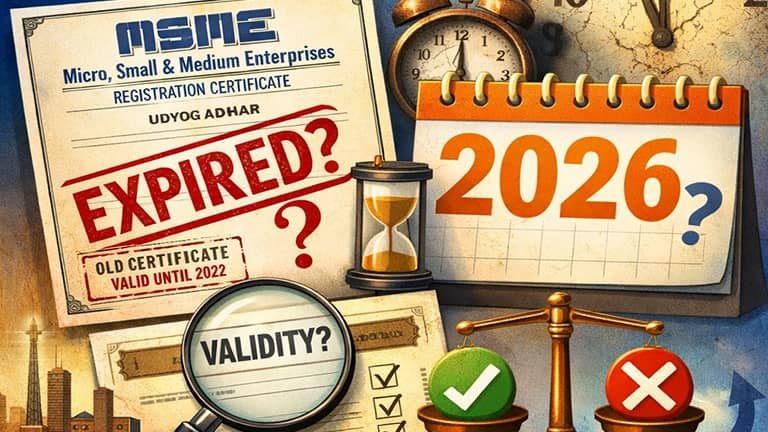
MSME registration provides access to government benefits, priority lending, and legal protections. However, when registration systems change, older certificates lose operational value if not aligned with current requirements. This guide clarifies the status of old MSME certificates in 2026.
Why Old MSME Certificate Validity Is a Concern
Business owners face several concerns about their older certificates:
- Rejection of documents during loan applications
- Ineligibility for government schemes or tenders
- Issues during audits or compliance checks
- Problems while updating business details
- Confusion during ownership changes or restructuring
MSME Certificates Before 2020
Pre-2020 MSME certificates were issued under earlier government frameworks with simpler registration processes and limited documentation requirements. Many details were self-declared. These certificates served as official proof of MSME status for bank loans, subsidy schemes, vendor registrations, government procurement, and compliance benefits.
What Changed in the MSME System After 2020?
Post-2020 reforms introduced a more structured framework aimed at improving transparency and ensuring accurate enterprise classification. Key changes included:
- Integration with PAN and tax databases
- Automatic classification based on turnover and investment
- Digital verification replacing manual declarations
- Unified national database for MSMEs
Old registration certificates were no longer considered sufficient for ongoing benefits.
Why Migration Became Necessary
The new system ensured all enterprises operate under a single, updated framework. Migration became necessary because:
- Old data was not linked to financial records
- Turnover and investment limits were revised
- Many businesses had outgrown their original category
- Banks and government portals shifted to the new system
Older certificates became historical records rather than active credentials.
Are Old MSME Certificates Still Valid in 2026?
The answer depends on intended use. Old MSME certificates:
- May still be valid as historical proof of business registration
- Can be useful for record-keeping or legacy documentation
- Are not accepted for new government benefits or schemes
- Are generally not sufficient for bank loans or tenders
Most government departments and financial institutions now require businesses to use the updated MSME system. Relying solely on older certificates can limit growth opportunities and create delays.
Why Updating Your MSME Certificate Is Important
An MSME certificate update ensures that your business details match current regulatory requirements. Updated registration reflects accurate turnover, investment, and business activity. Updating helps with:
- Faster loan approvals
- Eligibility for current government schemes
- Seamless tender participation
- Smooth compliance checks
- Reduced risk of document rejection
Risks of Not Updating Old MSME Registration
Continuing with an outdated certificate exposes businesses to:
- Loan applications may be rejected or delayed
- Government benefits may not be accessible
- Buyers may refuse MSME-related protections
- Payment delay protection may not apply
- Vendor registration issues may arise
Why Old MSME Records Still Matter
Despite insufficient status for active benefits, preserving old certificates remains important. These records serve as proof of business history for:
- Audits and compliance reviews
- Legal or contractual references
- Business valuation and due diligence
- Ownership transfers or restructuring
- Historical data verification
Businesses should retain old MSME documents even after migrating to the new system.
Common Myths About Old MSME Certificates
- "Old certificates are permanently valid" — Not for active benefits
- "Migration is optional" — Effectively required for scheme access
- "Updating may cancel existing benefits" — Migration preserves and extends benefits
- "Only large businesses need to update" — All MSMEs benefit from migration
Final Words
Old MSME certificates hold historical value but are no longer sufficient for accessing active government benefits, loans, or procurement opportunities. Businesses obtaining certificates before 2020 should treat migration and updates as essential compliance steps, ensuring uninterrupted access to schemes, financial support, and legal protections.