
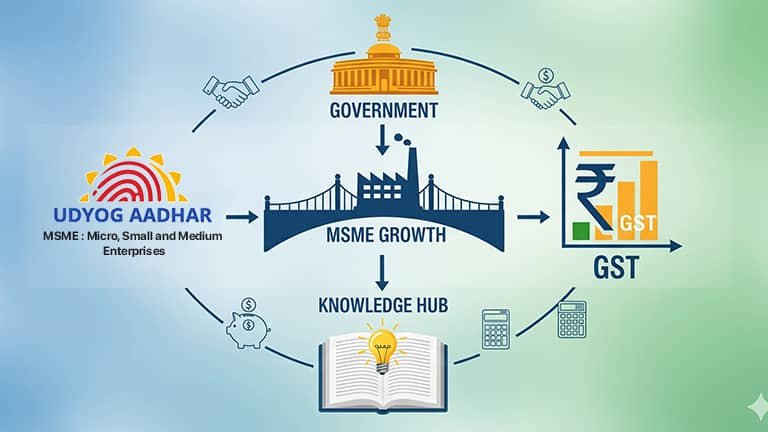
Udyog Aadhaar and GST are two distinct but complementary registrations for Indian businesses. Understanding how they differ — and how they work together — is essential for MSMEs seeking government benefits, credit, and compliance. GST is not mandatory to file Udyog Aadhaar, but these two registrations together can guarantee long-term benefits and credibility.
What is Udyog Aadhaar?
Udyog Aadhaar was a government initiative providing unique identification numbers to micro, small, and medium enterprises. It simplified access to subsidies, loans, and marketing assistance. Since July 2020, this system transitioned to Udyam Registration, though businesses frequently use the original terminology. Key aspects include:
- Easy online sign-up process
- Assigns a unique Udyam Registration Number (URN)
- Facilitates access by MSMEs to government incentives and credit programmes
What is GST?
Goods and Services Tax (GST) is a comprehensive tax levied in India on the sale of goods and services. It consolidated multiple indirect taxes into a unified taxation framework, simplifying compliance for businesses across India.
Who Needs GST Registration?
GST registration is mandatory for:
- Companies with annual turnover of ₹40 lakh or more
- E-commerce sellers
- Companies involved in inter-state supply
GST Vs Udyog Aadhaar: Key Differences
| Parameter | GST | Udyog Aadhaar (Udyam) |
|---|---|---|
| Purpose | Tax compliance for goods & services | MSME identification & benefits |
| Applicability | Based on turnover & nature of business | Applicable to all MSMEs |
| Registration Authority | GST Department | Ministry of MSME |
| Mandatory? | Yes, if turnover exceeds threshold | Voluntary but highly recommended |
GST is concerned with tax compliance, while Udyog Aadhaar is concerned with business recognition and government incentives.
Is it Compulsory to Enroll Under GST for Udyog Aadhaar?
No GST registration requirement exists for obtaining Udyam Registration. Manufacturers, traders, and service providers may register as MSMEs independently of GST status. However:
- Businesses exceeding the GST threshold turnover must register for GST
- Government tenders or schemes may require both registrations
Voluntary GST registration enhances business credibility and transaction efficiency even when not legally required.
Advantages of Udyog Aadhaar Being Linked to GST
Benefits of maintaining both registrations include:
- Unrestricted Access to Credits and Lending: Financial institutions prioritize businesses with dual registration
- Government Tenders and Subsidies: Most government contracts require both certifications for eligibility
- Tax Compliance and Transparency: GST compliance reduces penalty risks through legal adherence
- Amplified Credibility: Dual-registered enterprises gain supplier and client trust
How to Register as an MSME
- Visit the Udyam Registration Portal at udyamregistration.gov.in
- Input Aadhaar and PAN details of the business owner
- Enter business information including name, type, activity, and contact details
- Include GSTIN if available (optional but strengthens profile)
- Upon submission, receive Udyam certificate with unique Udyam Registration Number
Why MSMEs Should Possess Both Registrations
Combined registration offers significant competitive advantages:
- Legal Compliance: Avoids GST-related penalties
- Government Benefits: Access subsidies, preferential loans, and tax breaks through MSME schemes
- Increased Business Growth: Enhanced participation in tenders, trade fairs, and export initiatives
Conclusion
Both GST and Udyog Aadhaar/Udyam Registration form India's business compliance foundation. Though distinct in purpose, they complement each other for MSME growth. GST is not mandatory to file Udyog Aadhaar, but these two registrations together can guarantee long-term benefits, credibility, and seamless access to government schemes for your enterprise.