
The landscape of Indian Micro, Small, and Medium Enterprises (MSMEs) is constantly evolving, driven by the government's push for digital integration and streamlined compliance. For business owners who first registered their entity years ago, one question remains paramount in late 2025: Is Udyog Aadhaar still valid?
The short, unavoidable answer is a resounding no for practical purposes. If you are an MSME owner still relying solely on your original Udyog Aadhaar Memorandum (UAM) certificate, you are holding a legacy document that has been officially de-recognized by the Ministry of MSME for availing critical government schemes and benefits in 2025.
The government has successfully transitioned the entire MSME ecosystem to the Udyam Registration framework. This is not just a name change; it represents a fundamental overhaul of how MSMEs are classified, recognized, and supported. For every enterprise, ensuring your registration is current means securing your right to government support, accessing crucial credit, and maintaining regulatory compliance. This comprehensive guide provides the definitive MSME registration update for 2025, detailing why the change is mandatory and how you can ensure your business remains officially active.
The Dawn of Udyam: Why Udyog Aadhaar was Retired
The Udyog Aadhaar Memorandum (UAM), launched in 2015, was a revolutionary step that simplified MSME registration. It replaced the cumbersome Entrepreneurs Memorandum (EM Part-II) with a single-page, self-declaration process that required only the Aadhaar card. It served its purpose well by formalizing millions of small businesses.
However, the UAM system eventually reached its limitations. It lacked robust, real-time integration with other national databases, leading to inconsistencies and classification errors.
In response, the Ministry of MSME introduced the Udyam Registration system, effective from July 1, 2020. This new system was designed to address three core needs:
- 1. Seamless Integration: Udyam is fully integrated with the Income Tax Department (PAN) and the GST Network (GSTIN). This allows for automatic validation and eliminates the need for manual document submission.
- 2. Paperless and Self-Declaration: The process is 100% online and free, requiring no physical documents to be uploaded.
- 3. Dynamic Classification: The new system introduced a revised definition of MSMEs, based on both Investment and Annual Turnover criteria, ensuring that an enterprise’s classification (Micro, Small, or Medium) is dynamically updated based on official financial records.
Incorrect Classification: Without migrating, your business is not subject to the new MSME classification rules (effective April 1, 2025, as per the latest updates) and may be missing out on benefits specific to your actual size (e.g., if you are now classified as a 'Micro' enterprise).
This move marked the government’s commitment to transparency and efficiency, making the continued use of Udyog Aadhaar untenable.
The Official Verdict: Is Old Udyog Aadhaar Valid in 2025?
This is the most critical question for businesses registered pre-July 2020. Is your old Udyog Aadhaar valid today?
While the registration number itself (UAN) technically exists as a historical record of your enterprise, its validity as an official certificate for availing new government benefits expired long ago.
The Ministry of MSME provided multiple extensions to allow existing UAM holders to migrate to Udyam. The final extension date for the UAM certificate's official validity was typically June 30, 2022. After this date, the Udyog Aadhaar Memorandum ceased to be a recognized document for government schemes, tenders, and priority sector lending access.
The Consequences of Non-Migration in 2025
If you have not migrated your Udyog Aadhaar to Udyam Registration, your business may face several critical disadvantages in 2025:
- •Ineligibility for Schemes: You will be excluded from new and existing central and state-level MSME schemes, subsidies, and grants. For example, participation in large trade fairs like IITF 2025 now often mandates a valid Udyam Registration Number (URN).
- •Credit Difficulty: Banks and financial institutions rely heavily on the URN to verify MSME status, particularly for collateral-free loans under schemes like CGTMSE. An old Udyog Aadhaar valid status simply won't suffice for most modern lending products.
- •Lack of Protection: You cannot leverage the MSME Samadhan Portal for protection against delayed payments from buyers, a crucial benefit only available to Udyam-registered entities.
- •Incorrect Classification: Without migrating, your business is not subject to the new MSME classification rules (effective April 1, 2025, as per the latest updates) and may be missing out on benefits specific to your actual size (e.g., if you are now classified as a 'Micro' enterprise).
To summarize: While your business still exists, your formal recognition as an active, eligible MSME under the government’s current definition has lapsed if you haven't switched to Udyam.
Navigating the Mandatory MSME Registration Update in 2025
The move to Udyam is the largest and most important MSME registration update of the decade. The new classification is based on investment in plant/machinery/equipment AND annual turnover. This dual criteria ensures a more realistic categorization:
| Category | Investment (in Plant & Machinery/Equipment) |
Annual Turnover |
|---|---|---|
| Micro | Not more than ₹1 Crore | Not more than ₹5 Crores |
| Small | Not more than ₹10 Crores | Not more than ₹50 Crores |
| Medium | Not more than ₹50 Crores | Not more than ₹250 Crores |
Why Migration is Mandatory Now
The Udyam system leverages the government's centralized databases. When you migrate, the system automatically pulls your investment and turnover data from your Income Tax Returns (ITR) and GST filings. This means:
- 1. Zero Guesswork: Your enterprise is classified accurately and automatically.<
- 2. No Renewal Required: The Udyam Registration Certificate (URN) has lifetime validity. Unlike the UAM, which has an ambiguous shelf life, the Udyam certificate remains active unless your business exceeds the 'Medium' threshold.
- 3. Automatic Updation: If your business grows and crosses a classification threshold (e.g., from Micro to Small), the system automatically updates your category based on your latest ITR/GST filings, ensuring continuous compliance.
If you have a historical UAM, migrating is the only way to officially complete the MSME registration update and receive your permanent Udyam Registration Number.
Checking Your Udyog Aadhaar Active Status and Migration Steps
While the term "Udyog Aadhaar active status" is outdated, you can still verify your old registration details and use them as the gateway to Udyam.
Verification vs. Migration
In 2025, when checking your status, you are essentially looking to see if your old details are correct before you migrate.
- Verification: You can verify your old UAM details on the Udyam portal by entering your 12-digit Udyog Aadhaar Number (UAN) and the registered mobile number. This is purely for record-keeping and data correction.
- Migration: This is the necessary step to convert your old UAM into a new, official Udyam Registration Number (URN).
Step-by-Step Guide to Migrate Udyog Aadhaar to Udyam
The migration process is simple, free, and can be completed online.
Step 1: Access the Migration Portal
Visit the official Udyam Registration portal. Select the option designated for "Those already having registration as UAM."
Step 2: Authenticate and Fetch Details
Enter your 12-digit Udyog Aadhaar Number (UAN) and choose the OTP verification method (via registered mobile or email). Once verified, the system will fetch your old business details.
Step 3: Update and Re-Classify
The system will prompt you to provide your PAN and GSTIN (if applicable). This is where the core MSME registration update takes place. Based on the financial data linked to your PAN, the system will automatically re-calculate your investment and turnover and issue a new, precise classification (Micro, Small, or Medium).
Step 4: Receive Your Udyam Registration Number (URN)
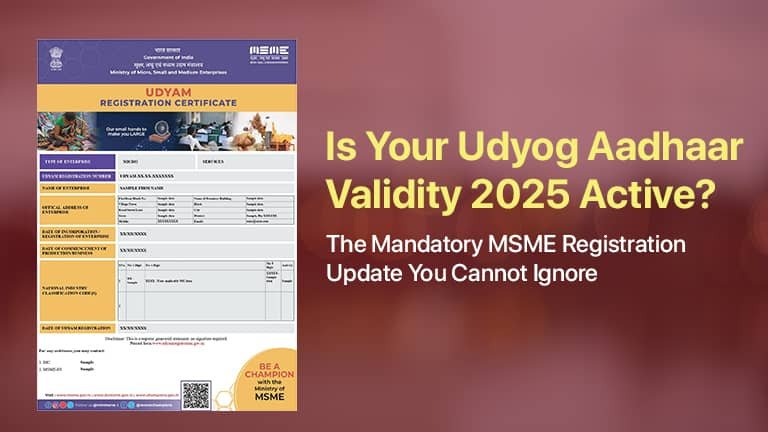
Upon successful submission and verification, you will receive your Udyam Registration Number. This 19-digit number is the official proof of your MSME status and provides the only true "Udyog Aadhaar active status" recognized in 2025.
Why Delaying Migration is a Risk to Your Business
Every day that passes without migrating your UAM to a URN means your business is operating without official MSME recognition. This is a significant risk in a competitive environment where compliance is paramount.
Key Benefits Reserved for Udyam Holders:
| Benefit | Description |
|---|---|
| Priority Sector Lending (PSL) | Access to loans at lower interest rates and preference in credit disbursement from banks. |
| Government Tenders | Exemption from Earnest Money Deposit (EMD) and Security Deposit (SD) in most central and state government tenders, giving Udyam-registered businesses a competitive edge. |
| Taxes & Exemptions | Eligibility for specific income tax exemptions and reduced fees for filing patents and trademarks. |
| Infrastructure Subsidies | Access to schemes related to technology up-gradation, quality management standards (like ISO certification), and setting up modern infrastructure. |
| Delayed Payment Protection | The statutory right to claim interest on delayed payments, enforced through the MSME Samadhan portal. |
Conclusion: Securing Your Future in 2025
The government has made its intent clear: the era of Udyog Aadhaar is over, and the future belongs to the seamlessly integrated Udyam Registration framework.
The question is no longer "Is my Udyog Aadhaar validity 2025 active?" but rather, "When will I complete my mandatory transition to Udyam?"
To ensure your enterprise is fully compliant and eligible for every government benefit, subsidy, and financial incentive available in 2025, migrating your old UAM is non-negotiable. Don't let your business fall behind due to a lapsed technicality. Secure your future and legitimacy by completing the MSME registration update today.