
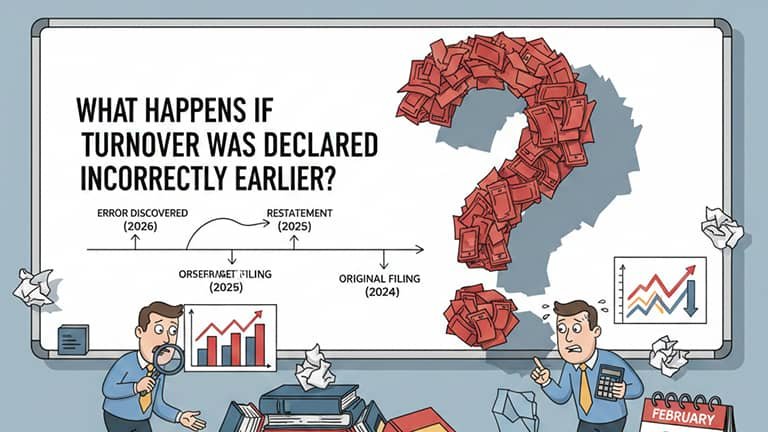
Declaring incorrect turnover figures represents a widespread challenge among small and growing businesses in India. These declarations prove surprisingly frequent due to various operational factors, and understanding what to do when this happens is essential for every MSME owner.
Why Incorrect Turnover Declarations Are Common
Common reasons include:
- Incomplete accounting records
- Confusion between gross turnover and taxable turnover
- Mismatch between GST returns and business records
- Estimation errors during early years
- Business growth not reflected on time
- Dependence on third-party accountants without verification
Most errors occur unintentionally, yet overlooking them creates serious compliance difficulties.
How Government Systems Detect Turnover Mismatch
Modern government portals maintain high integration levels. Turnover verification uses multiple data sources:
- Income tax filings
- GST returns
- PAN-linked financial data
- Bank and lending records
Mismatched declared turnover triggers automatic system flags, resulting in notices, reclassification, or delayed approvals.
MSME Turnover Correction: Is It Allowed?
Yes, MSME turnover correction is allowed and encouraged when errors are identified. The government recognizes that business evolution permits mistakes. Key priorities include correcting the data voluntarily, acting before penalties are triggered, and ensuring future declarations are accurate. Voluntary correction substantially reduces penalty and compliance action risks.
What Problems Can Incorrect Turnover Cause?
Mismatched business turnover creates multiple enterprise challenges:
- Change in MSME classification
- Loss of eligibility for schemes
- Loan application rejection
- Delay in approvals and certificates
- Compliance notices
- Reduced credibility with banks and vendors
MSME Reclassification: A Common Outcome
Incorrect turnover directly causes MSME reclassification. Corrected figures exceeding category limits may shift enterprises from Micro to Small, or from Small to Medium. Reclassification represents accurate business size reflection rather than punitive action. However, benefit impact remains significant since specific schemes restrict access to micro or small enterprises only.
MSME Penalty Rules: Should You Be Worried?
Under actual MSME penalty rules, penalties typically apply when:
- False information is declared intentionally
- Corrections are ignored despite warnings
- Fraudulent misrepresentation is detected
- Turnover is hidden deliberately
If the error was genuine and corrected voluntarily, penalties are rarely imposed. Transparency and prompt action outweigh perfection.
What To Do If You Declared Turnover Incorrectly
Follow these sequential steps:
- Identify the Exact Error — Check GST returns, income tax filings, and financial statements to pinpoint mismatch sources
- Correct Accounting Records — Ensure books of accounts reflect accurate turnover figures
- Update Business Records — Initiate correction through appropriate online channels
- Monitor Classification Status — Track MSME category changes following correction
- Maintain Future Accuracy — Guarantee future filings align across all systems
Early correction prevents subsequent complications.
Impact on Loans and Credit Facilities
Banks heavily depend on MSME records during loan evaluation. Incorrect turnover creates several effects:
- Loan approvals may get delayed
- Credit limits may be revised
- Collateral-free loan eligibility may change
- Trust with lenders may be affected
Accurate turnover substantially improves credibility and financing access.
Can Incorrect Turnover Affect Government Benefits?
Yes, incorrect turnover impacts subsidies, incentives, procurement eligibility, tender participation, and MSME scheme access. Correction represents both a compliance necessity and a way to protect your entitlements.
Why Voluntary Disclosure Is Always Better
Authorities detecting errors independently increases risk substantially. Voluntary correction shows good faith and reduces scrutiny. Proactively correcting records demonstrates compliance and trustworthiness to banks and government bodies.
How to Avoid Turnover Mistakes in the Future
Prevention strategies include:
- Maintain proper books of accounts
- Reconcile GST and tax data regularly
- Avoid guesswork during declarations
- Review filings annually
- Seek professional advice when unsure
Common Myths About Turnover Errors
- "A small mistake doesn't matter" — it does, as digital systems treat all data seriously
- "Correction will trigger penalties" — usually false for genuine voluntary corrections
- "Once declared, it can't be changed" — incorrect, corrections are allowed
- "Only big businesses are monitored" — not true, all MSME data is verified
Final Thoughts
Incorrect turnover declarations represent common yet correctable issues. Response speed and responsibility determine outcomes once discovered. Understanding the implications, initiating correction processes, accepting possible reclassification, and recognizing penalty conditions maintains compliance and confidence. Accurate data establishes trust, protects benefits, and ensures business sustainability.